Artificial intelligence is becoming part of everyday life. It helps us write emails, translate languages, organise photos, generate content, and answer questions in seconds. Increasingly, AI is also moving from cloud-based services into the devices we use every day.
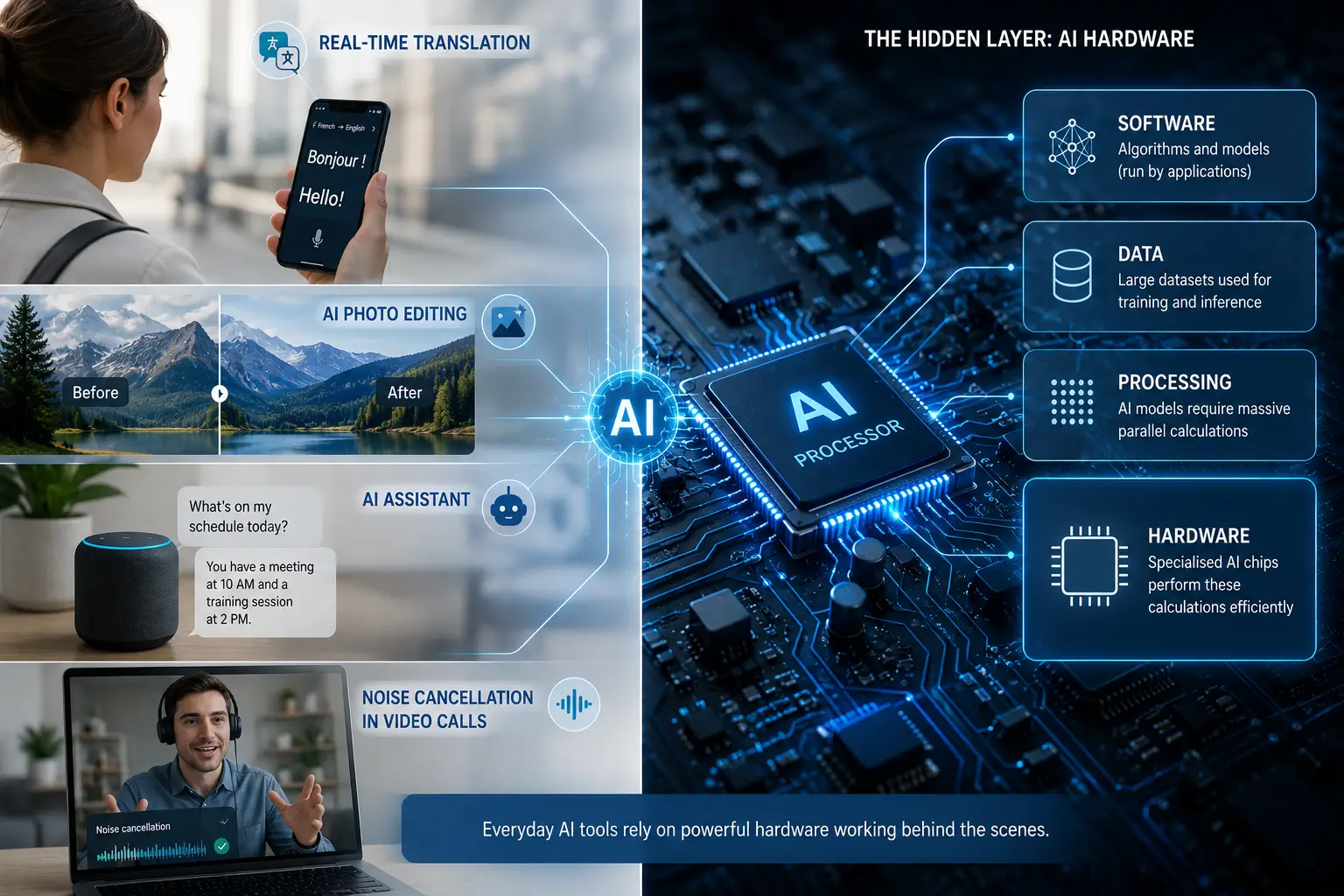
Many new laptops and smartphones now include dedicated AI features. Consider a modern smartphone: real-time language translation, background noise removal during video calls, and AI-assisted photo editing can increasingly run directly on the device rather than relying entirely on cloud services. These capabilities are made possible by dedicated AI processors built into the hardware.
This raises an interesting question: If AI is software, why does it suddenly require new types of computer hardware? The answer lies in AI chips.
More Than Just a Faster Processor
Despite the name, AI chips are not intelligent themselves. They do not think, learn, or make decisions. Instead, they are specialised processors designed to perform the enormous number of calculations required by modern AI systems.
When a chatbot generates a response or an AI tool recognises an image, it performs millions or even billions of mathematical operations. Traditional processors (CPUs) are designed to handle many different computing tasks. AI systems, however, rely heavily on performing large numbers of similar calculations simultaneously. To support this, engineers developed specialised processors such as GPUs (Graphics Processing Units) and NPUs (Neural Processing Units), which can handle these workloads much more efficiently.
In simple terms, AI chips are not artificial intelligence. They are the hardware that makes artificial intelligence practical.
Why Are AI Chips Suddenly a Global Topic?
Only a few years ago, discussions about AI focused mainly on algorithms and software. Today, AI chips have become a strategic technology. One reason is the rapid growth of generative AI. Systems such as ChatGPT, image generators, and AI assistants require significant computing power. At the same time, users increasingly expect AI tools to be faster, more private, and available directly on their devices.
This is why manufacturers are now integrating dedicated AI processors into laptops, smartphones, and other consumer technologies. Instead of sending every request to a remote server, some AI tasks can be processed locally. This can reduce delays, improve privacy, and lower the amount of data that needs to be transferred. The result is a shift from AI as an online service to AI as a built-in capability of everyday devices.
What Does This Mean for Education and Work?
The educational challenge is no longer only how to teach learners to use AI tools, but how to help them understand the systems behind them. As AI becomes embedded in devices, workplaces, and public services, a basic understanding of how these technologies operate is becoming part of digital literacy.
Most discussions about AI focus on how to use AI tools effectively. However, future workers will increasingly encounter AI systems embedded in machines, vehicles, industrial equipment, healthcare technologies, and personal devices. Understanding the foundations of these systems is becoming increasingly important.
At the same time, the AI economy extends far beyond software development. Behind every AI application is an ecosystem of engineers, technicians, manufacturers, cybersecurity specialists, and infrastructure experts who design, produce, optimise, and maintain the hardware that makes these systems possible.
This creates opportunities not only in computer science, but also in electronics, advanced manufacturing, robotics, semiconductor technologies, and industrial engineering.
Looking Beyond the AI Application
When we think about artificial intelligence, we usually focus on what AI can do. Yet every AI-generated answer, image, or recommendation depends on physical hardware operating somewhere in the background.
As AI becomes increasingly embedded in the devices we use every day, digital literacy may involve more than knowing how to use AI tools. It may also require understanding the technologies that power them.
An important question therefore emerges: Will future digital literacy mean knowing how to use AI or also understanding the technologies that power it?
The next generation of learners may not only use AI; they may help build the infrastructure behind it.