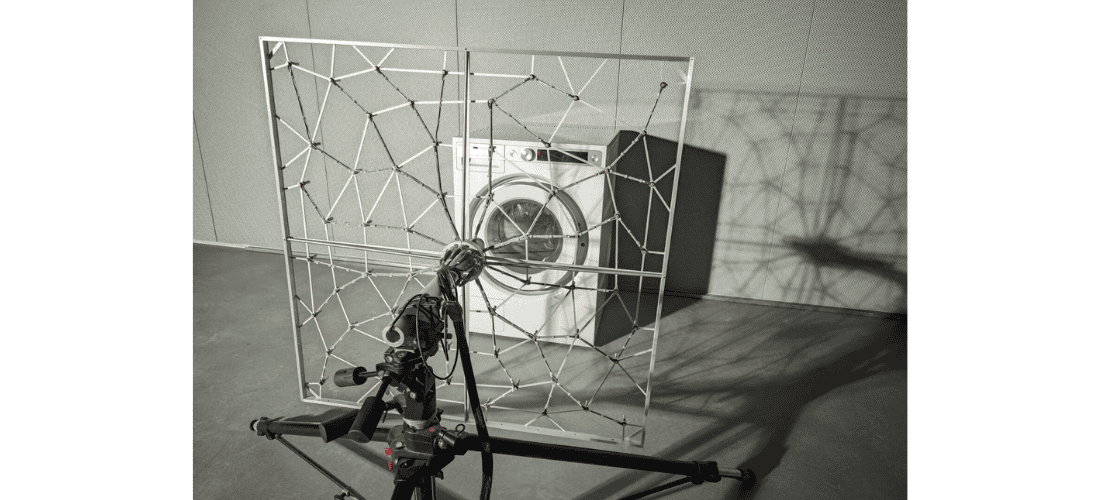
How artificial intelligence and digital twins were used to develop a quieter, more energy-efficient home appliance — without building dozens of physical prototypes.
Fewer prototypes. Less energy. Less noise. Arctur, one of our AI4VET4AI partners, worked with Gorenje and Dewesoft to show what happens when you let AI loose on a refrigerator design — and the results were better than expected.
Did You Know? A Refrigerator Can Have a Digital Twin
A digital twin is a virtual replica of a real physical system — in this case, an entire refrigerator, including the compressor, condenser, evaporator, and capillary tube. Instead of building and testing multiple costly physical prototypes, engineers can simulate the whole system on a computer, tweak thousands of parameters, and instantly see how each change affects energy use, temperature, or noise.
Arctur’s team combined this digital twin with an AI optimization algorithm that automatically searched for the best possible component settings — pipe lengths, diameters, thermal conductivity, compressor speed — to maximise efficiency. High-performance computing (HPC) made it possible to run many complex scenarios simultaneously, compressing weeks of testing into a fraction of the time.
“The digital twin allowed us to see how the individual components of the refrigerator interact, without relying on physical prototypes. This let us quickly test different configurations and gain a clearer understanding of how each parameter affects energy consumption.”
— Tomislav Šubić, Head of AI, Arctur
The Result: Energy Class A and Just 29 dB
The AI-supported approach paid off. The refrigerator achieved EU Energy Class A — one of the highest efficiency ratings — and a declared noise level of just 29 dB, quieter than a whisper. These targets were not just met — they were surpassed. And the number of physical prototypes needed was significantly reduced, saving both time and cost.
“The digital twin served as a virtual laboratory that allowed us to test ideas, optimise system performance, and significantly reduce the number of prototypes. This approach played a key role in achieving — and ultimately surpassing — our targets.”
— Dejan Dren, Team Leader Predevelopment, Gorenje d.o.o.
What AI Skills Are Behind This?
This project shows AI at work in a practical, cross-disciplinary setting. The key competences involved: optimization algorithms, simulation and modelling, high-performance computing, and data-driven decision-making. These skills are in growing demand across manufacturing, engineering, and product development sectors throughout Europe.
This work was carried out within the R-NEA-SV project in collaboration with Gorenje and Dewesoft. Learn more: arctur.si/en/rd-projects/r-nea-sv