At the European Peer Learning Activity (PLA) on Artificial Intelligence and Quality Assurance held in Split, Croatia, Italy presented its strategic roadmap for integrating AI into Vocational Education and Training (VET). Delivered by Marianna Forleo on behalf of the EQAVET National Reference Point Italy (INAPP), the presentation highlighted how Italy is navigating the digital transition by blending ethical rigor, legislative innovation, and human capital development.
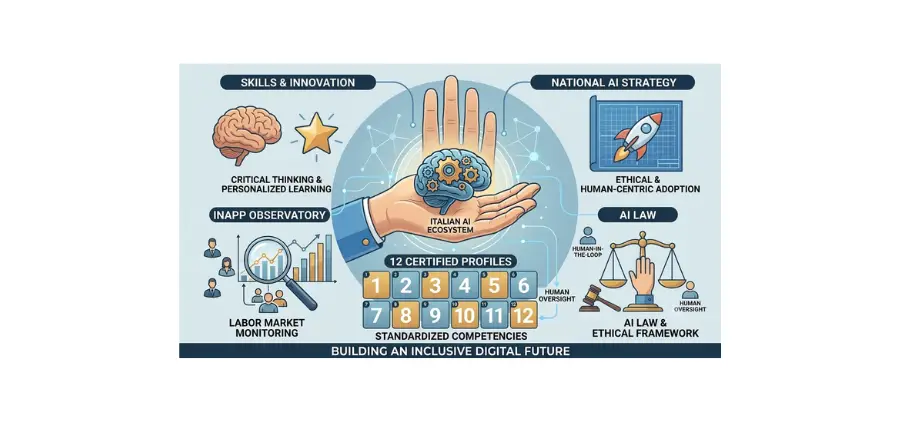
In the age of AI, basic reading and writing are no longer enough. The rapid rise of AI-driven deepfakes and manipulated content makes “Data Literacy” essential to protect citizens from disinformation. An effective Data Literacy strategy should be organized around 1) Personalized Learning, focused on the way AI is boosting the shift of education from rigid, standardized systems to dynamic, hyper-personalized, and inclusive learning ecosystems; 2) Cognitive Rights, which are essential to make training go beyond employability by fostering the critical thinking needed to protect citizens’ cognitive rights and ensure safe, informed digital citizenship; 3) Quality Assurance (EQAVET), based on the integration of AI into VET according to the European Quality Assurance in Vocational Education and Training (EQAVET) framework to transform quality control into a continuous, data-driven improvement process.
Aligned with the landmark EU AI Act, Italy’s national strategy champions a human-centric, ethical, and sustainable approach to AI. It aims to boost productivity and public services without replacing human agency. The strategy focuses on four key pillars:
- Research: Strengthening centers of excellence and attracting global talent.
- Public Administration: Improving public services while ensuring algorithmic transparency and privacy.
- Businesses: Supporting AI adoption in SMEs to drive competitiveness.
- Training: Implementing massive upskilling and reskilling programs to prepare the workforce for the future.
With the enactment of Law n. 132/2025, Italy established its first comprehensive national legislative framework for AI. The law mandates “human-in-the-loop” oversight, ensuring that final decisions always rest with a human. Under this framework, Italy has become the first European country to officially standardize 12 key AI professional profiles under the national standard UNI 11621-8:2026. These certified roles help organizations build qualified teams and guide training institutes (like ITS Academies) in designing market-relevant curricula.
To monitor how these rapid changes affect workers, Law 132/2025 established the Observatory on the Adoption of AI Systems in the Labor Market under the Ministry of Labor. Supported scientifically by INAPP, the Observatory focuses on: 1) Analyzing AI’s impact on employment rates and emerging job roles; 2) Designing transition strategies to increase productivity while ensuring no worker is left behind; 3) Protecting worker privacy and ensuring fairness in automated environments.
The synergy between Italy’s National AI Strategy, Law 132/2025, the new labor observatory, and modernized VET programs forms a cohesive roadmap. By setting clear ethical boundaries and certifying high-value skills, Italy is building an inclusive digital future where technology serves as a core driver of human potential and economic resilience.