Agentic AI refers to artificial intelligence systems that can act more independently than traditional AI tools: they can plan tasks, make decisions, use digital tools, adapt to learner needs, and support users through multi-step processes. In education, this moves AI beyond simply generating text or answering questions. Agentic AI can act as a personalised learning assistant, a teaching co-pilot, a curriculum support tool, a feedback generator, or an administrative assistant that helps reduce workload for educators. Its value is not in replacing teachers, but in helping teachers focus more on high-quality teaching, mentoring, creativity, inclusion, and pastoral support.
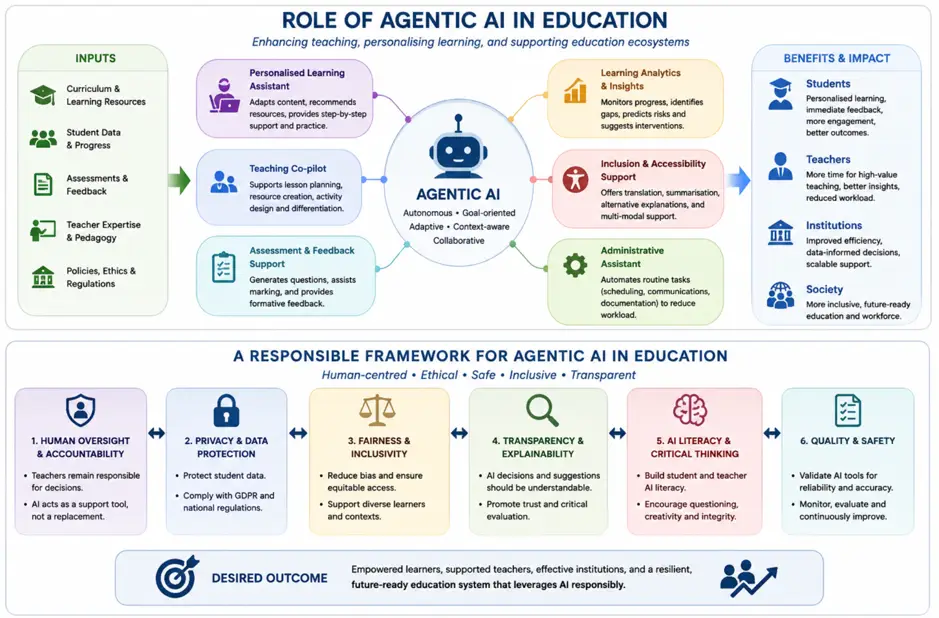
One of the strongest roles of agentic AI is personalised learning. It can analyse a learner’s progress, identify gaps in understanding, recommend resources, generate practice questions, and adapt explanations to the learner’s level. For example, a student struggling with cryptography, programming, or mathematics could receive step-by-step guidance, targeted exercises, and immediate formative feedback. This is particularly useful in large classes, where teachers may not have enough time to provide individual support to every student. Agentic AI can also support inclusive education by helping learners with different abilities, language backgrounds, or learning preferences through translation, summarisation, audio support, accessible materials, and alternative explanations as sketched in the diagram below.
For teachers, agentic AI can support lesson planning, assessment design, resource creation, marking assistance, and feedback drafting. In the UK, the Department for Education states that teachers can use AI for lesson planning, creating resources, marking, feedback, and administration, while making clear that professional judgement and final responsibility remain with teachers and schools. The UK has also published support materials to help schools and colleges use AI safely and effectively, showing that the policy direction is not simply to ban AI, but to integrate it responsibly.
Across Europe, several countries are already developing national approaches. Estonia is one of the clearest examples. Its AI Leap 2025 programme gives students and teachers access to AI-powered learning tools and training on effective use. Around 20,000 students in grades 10–11 and 3,000 teachers were expected to gain access from September 2025, with wider expansion planned. This shows a proactive national model where AI literacy, teacher training, and equitable access are treated as essential parts of education reform.
France has also moved towards structured adoption. In 2025, France announced educational AI initiatives funded through France 2030, including work on sovereign AI tools to support teachers with lesson preparation and assessment from the 2026 school year. France has also published a national framework for AI use in education, covering pedagogical and administrative uses of generative AI. This is important because agentic AI in schools cannot rely only on commercial tools; countries also want trusted, locally governed systems aligned with national curricula and data protection rules.
Italy has taken a regulatory and ethical route. In 2025, Italy published guidelines for the introduction of AI in schools, aiming to promote human-centred, secure, reliable, ethical and responsible AI, while increasing awareness of both opportunities and risks. Italy also passed a comprehensive AI law aligned with the EU AI Act, requiring human oversight, transparency, privacy protection and child safeguards across sectors including education. This highlights a key issue for agentic AI: because these systems can make recommendations and guide decisions, they must remain explainable, supervised and accountable.
Finland provides another useful example through its strong tradition of media literacy and digital resilience. Finnish education has long emphasised the ability to evaluate information critically, and recent efforts include helping students identify AI-generated content and misinformation. Finland’s education authorities have also produced material on AI in education to support safe, responsible and innovative use across early childhood education, general education and vocational education. This matters because agentic AI is only beneficial when students understand its limitations, bias, hallucinations and ethical risks.
At the EU level, the wider direction is towards ethical, human-centred and legally compliant AI in education. The European Commission has updated guidelines for educators on the ethical use of AI and data, highlighting the rise of AI use in education, the requirements of the AI Act, and the need for ethical and critical AI literacy. Similarly, European Schools have developed a framework for generative AI that aims to support effective use while remaining legal, inclusive, human-centred and ethical.
Overall, agentic AI has the potential to transform education by making learning more personalised, teaching more efficient, assessment more formative, and administration less burdensome. However, its success depends on strong safeguards: teacher oversight, data protection, transparency, academic integrity, bias management, and equal access. The best model is not “AI instead of teachers”, but AI with teachers: agentic systems supporting human expertise, while educators retain professional judgement, ethical responsibility and the human relationships at the centre of learning.